CLASS EPX-340



Description
Application Areas
- In aircraft hangars,
- In automobile factories,
- In healthcare-related laboratories and paint shops,
- In electrical and electronics laboratories,
- It can be applied in areas where flammable materials are stored or handled, even at low temperatures.
Application Information
Conductive Primer Layer:
Do not blind the primer with sand. Freshly applied CLASS EPX-150 must be protected from moisture, condensation, and water for at least 24 hours. Do not allow the primer to puddle on the surface. Proceed with the application of the CLASS EPX-340 conductive layer only after the primer layer has become touch-dry over the entire surface. Otherwise, risks of surface wrinkling, excessive elasticity, or impaired conductive properties may occur.
Conductive Topcoat Layer:
Topcoat application thickness: ~1.5 mm. Excess thickness (material consumption greater than 2.25 kg/m²) will result in reduced conductivity. Prior to applying a conductive flooring system, a mock-up reference area must be applied. This reference area must be evaluated and approved by the contractor/client. The required conductivity value and conductivity test method must be defined in the specification and application method statement.
Fixing Grounding Plates:
Each grounding point can provide conductivity for an area of 100 m2. Ensure that the maximum distance between grounding points does not exceed 10 m. Carefully clean the grounding points. Additional plates must be used for longer distances. If site conditions do not permit the installation of additional grounding plates, long distances (>10 m) must be interconnected using copper tapes. Grounding points must be connected to the building's main grounding system. This procedure must be executed and certified by a qualified electrical engineer in accordance with applicable regulations.
Number of Grounding Connections:
A minimum of 2 points is required per room. The optimal number of grounding connections depends on local conditions and must be specified in the project documentation. Inadequate assessment and improper treatment of cracks may reduce service life, and crack reflection through the coating can eliminate or reduce electrical conductivity. To ensure complete color uniformity of the coating, verify that CLASS EPX-340 applied in the same continuous area originates from the same production batch. In certain cases, point loading combined with underfloor heating systems or elevated ambient temperatures may leave impressions on the resin. If heating the application area is necessary, do not use gas, oil, paraffin, or other fossil fuel heaters. These release high volumes of CO2 and H2O water vapor, which adversely affect surface finish. For heating purposes, exclusively use electric warm-air blower systems.
Consumption
1.5 kg for 1 mm thickness.
Packaging
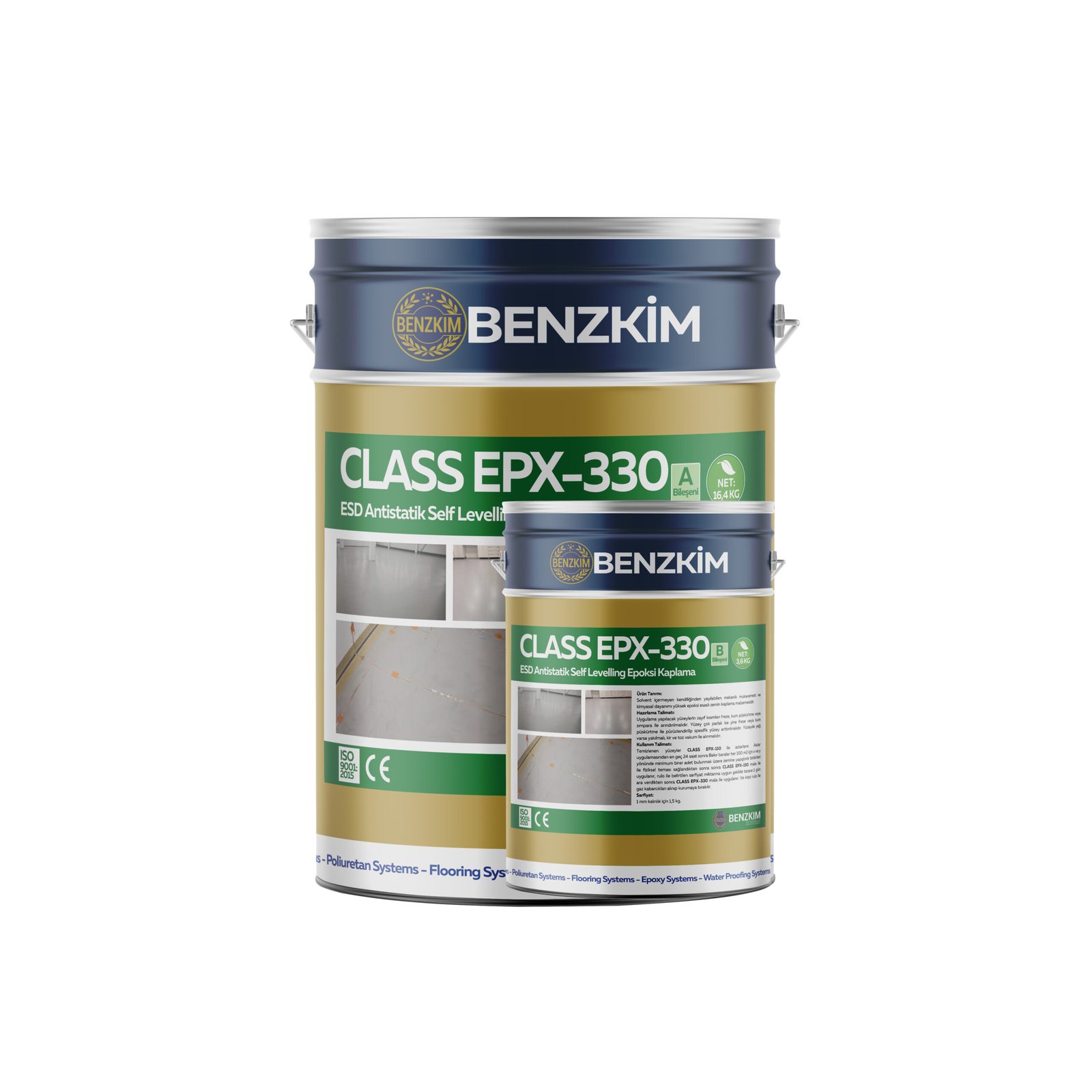
A/B: 17.4 + 2.6 = 20 kg set